
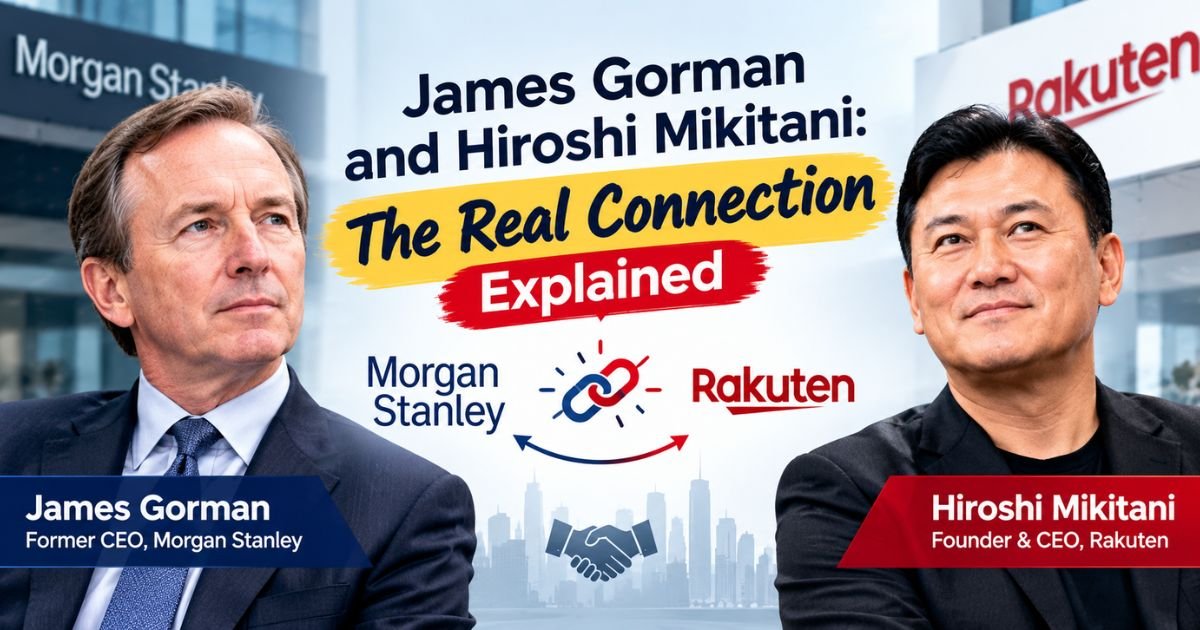
When people search for James Gorman and Hiroshi Mikitani, they often expect a hidden business deal or a shared boardroom seat. The documented reality is more interesting: no joint venture or partnership links the two, but their careers make one of the best side-by-side studies of how global companies are led.
James Gorman ran Morgan Stanley as CEO from 2010 to 2023 and now chairs The Walt Disney Company, while Hiroshi Mikitani founded Rakuten in 1997 and still leads it as chairman and CEO. One built his reputation by transforming an existing institution and handing it over cleanly. The other built an ecosystem from scratch and is still expanding it.
This guide covers who each man is, their careers, net worth and salary questions, family details, company finances and key differences. It also explains the one real, indirect link: Morgan Stanley’s role in some of Rakuten’s capital-markets deals.
Quick stats at a glance
| Metric | Figure |
| Gorman’s tenure as Morgan Stanley CEO | January 2010 to December 2023 |
| Gorman’s Disney chair role | Since January 2025 |
| E*TRADE deal value | $13 billion (all-stock) |
| Rakuten FY2025 revenue | ¥2.5 trillion (+9.5% YoY) |
| Rakuten record-revenue streak | 29 consecutive years |
| Rakuten FY2025 net loss | ¥177.9 billion |
| Rakuten Mobile subscriptions (March 2026) | 10.36 million |
| Rakuten Q2 2026 net profit | ¥227.2 billion |
James Gorman Author
Searches for “James Gorman author” mix up two different people. The best-known author with this name is a science journalist, which is a separate person from the banker discussed here. The Morgan Stanley and Disney executive is known for his leadership record rather than for a signature book.
The banker’s profile is well documented. He began as a lawyer in Melbourne, moved into consulting at McKinsey, then held senior roles at Merrill Lynch before joining Morgan Stanley in 2006, according to his General Atlantic biography. His education includes degrees from the University of Melbourne and an MBA from Columbia.
If you are looking for a book by the executive, none stands out as his defining work. His public record is better understood through his actions as CEO and chairman.
James Gorman Wife
Gorman keeps his family life largely out of the press. He is reportedly married, but he rarely discusses his spouse in interviews [verify]. Unlike many Wall Street leaders, he has not built a public persona around family.
This privacy matches his reputation as a disciplined, work-focused executive. Most coverage centers on strategy, acquisitions and succession planning rather than his home life.
For readers wanting personal details, the most reliable sources are major profiles in outlets such as the Financial Times, Bloomberg or Forbes.
James Gorman Net Worth

There is no single verified figure for Gorman’s net worth. Online estimates usually rely on his disclosed Morgan Stanley compensation and stock holdings, which change with the share price, so treat any figure as an approximation.
His wealth was built over more than a decade as CEO. He led the firm from January 2010 until December 2023, and equity-based pay was a major part of his compensation.
If you publish a number, cite a named source such as Forbes or Bloomberg and include the date.
James Gorman Salary
Gorman’s compensation at Morgan Stanley was disclosed in annual proxy filings and ran to tens of millions of dollars a year, mostly in stock awards and incentives rather than base salary [verify exact year-by-year figures in Morgan Stanley’s proxy statements].
His role changed in stages. He served as CEO until December 2023, as executive chairman through 2024, and became chairman emeritus in January 2025. Each stage carried different responsibilities and pay.
For accuracy, link readers to the SEC filing itself rather than relying on secondary summaries.
James Gorman Children
Gorman is reportedly a father, but he does not publicize details about his children [verify]. His public appearances focus on business, and his family is rarely mentioned.
This is common among senior financial executives, who often protect their families from media attention. Avoid speculating about names or ages unless a credible source provides them.
If you include family information at all, keep it short and sourced.
James Gorman Morgan Stanley
Gorman’s name is closely tied to Morgan Stanley’s modern identity. He transformed the bank after it nearly collapsed during the global financial crisis. He steered it toward a more stable, fee-driven business model.
He joined the firm in February 2006 and was named Co-President in December 2007, just as the crisis was approaching. He became CEO in 2010, and wealth management became the firm’s defining strategy.
His tenure is now treated as a case study in repositioning a Wall Street firm after a crisis.
Who Are James Gorman and Hiroshi Mikitani?
James Gorman is an Australian-born finance executive best known for leading Morgan Stanley and, more recently, chairing The Walt Disney Company. He is also a senior advisor at General Atlantic. His career is rooted in traditional institutions and the boardroom.
Hiroshi Mikitani is the founder, chairman and CEO of Rakuten Group in Japan. Rakuten was founded in 1997 and grew into a large internet services company with more than 70 services across e-commerce, fintech, digital content and communications. He is an entrepreneur rather than a hired executive.
Searchers pair the two names because both are prominent in global business with strong ties to finance, but their paths differ sharply.
| James Gorman | Hiroshi Mikitani | |
| Nationality | Australian-born, US-based | Japanese |
| Best known for | Morgan Stanley, Disney chair | Founding Rakuten |
| Leadership type | Professional executive | Founder-CEO |
| Education | Melbourne (BA, LLB), Columbia MBA | Hitotsubashi, Harvard MBA |
What Is the Connection Between James Gorman and Hiroshi Mikitani?
There is no documented personal or corporate partnership between the two men. A search of public sources found no joint venture, shared board seat or public collaboration, and readers should be told this plainly.
The indirect link runs through capital markets. Morgan Stanley was among the banks that handled Rakuten’s $450 million senior notes offering in January 2023, and a Morgan Stanley entity was also among the international joint lead managers on Rakuten’s ¥264.9 billion (about $1.9 billion) global share offering in July 2023. That is an institutional client-bank relationship, not proof the two men worked together.
The more useful connection is thematic. Both led large, complex organizations through major strategic shifts, and comparing them shows two different models of leadership.
Also Read More: Visit Shayari
James Gorman’s Career and Morgan Stanley Transformation
Gorman’s career moved from law to consulting to banking. After McKinsey and Merrill Lynch, he joined Morgan Stanley and took over as CEO in 2010, with the aftershocks of the crisis still shaping the industry.
His defining move was reducing reliance on volatile trading revenue and building steadier income. That meant betting heavily on wealth and asset management.
By the time he left the CEO role in December 2023, Morgan Stanley was widely seen as a very different company from the one he joined.
Expansion of Wealth Management
Morgan Stanley’s $13 billion all-stock takeover of ETrade was followed by a $7 billion cash-and-stock purchase of Eaton Vance. ETRADE brought over 5.2 million client accounts and over $360 billion of retail client assets, added to Morgan Stanley’s existing 3 million client relationships and $2.7 trillion of client assets.
The combined platforms had $3.1 trillion in client assets, with estimated cost savings of about $400 million. The strategy made earnings steadier and changed how investors valued the bank.
Gorman’s Succession at Morgan Stanley
Gorman planned his exit openly. In 2023 he said he expected to step down as CEO within 12 months and move to executive chairman, naming three internal finalists, which was unusual on Wall Street.
Ted Pick took over as CEO while the other two candidates stayed with the firm, avoiding the executive exodus that often follows a succession contest. This reputation for orderly handovers led directly to his Disney role.
James Gorman’s Role at Disney
Disney named Gorman its chairman after he stepped down as Morgan Stanley’s executive chairman at the end of 2024. He had already been leading the board’s succession planning committee.
His central task was choosing the next CEO. On February 3, 2026, Disney announced that Josh D’Amaro would become CEO, taking over on March 18 at the annual meeting and replacing Bob Iger. Dana Walden became president and chief creative officer.
D’Amaro joined Disney in 1998 and became chair of Disney Experiences in 2020, and Gorman had been managing the succession process. The appointment shows how his reputation shifted from banker to governance and succession specialist.
Who Is Hiroshi Mikitani?
Mikitani is a Japanese entrepreneur who started his career in banking before founding Rakuten. He studied at Hitotsubashi University and holds an MBA from Harvard Business School. He is widely known by the nickname “Mickey.”
Rakuten launched in 1997 with a mission centered on creating value through innovation and entrepreneurship. Under his leadership it grew from an online marketplace into a broad consumer services group.
He is also a cultural and civic figure, serving as chairman of the Tokyo Philharmonic Orchestra and as a representative director of the Japan Association of New Economy.
Hiroshi Mikitani Children
Mikitani keeps his family life private, and little reliable information about his children is public [verify]. Most profiles center on his business rather than his household.
Because Rakuten is a founder-influenced company, readers sometimes assume heirs are involved in management. There is no strong public evidence of that, so avoid implying it.
If you cover this topic, state that information is limited rather than filling the gap with rumor.
Hiroshi Mikitani Son
Searches for his son reflect curiosity about succession. No major public record establishes a son’s role at Rakuten [verify], and Mikitani remains firmly in charge as chairman and CEO.
The question matters because founder-led companies eventually face leadership transitions. That contrasts with Gorman’s very public succession work.
Until the company says otherwise, treat any claim about a family successor as unconfirmed.
Hiroshi Mikitani Daughter
Like other family questions, this one has little verified public information [verify]. He rarely discusses his children in interviews, and Rakuten’s corporate materials do not feature them.
This restraint is consistent with how he presents himself, as a founder focused on strategy, technology and Japan’s economy.
Responsible content should avoid naming private individuals without solid sourcing.
Hiroshi Mikitani Wife
Details about Mikitani’s spouse are also sparse in reliable sources [verify]. He tends to discuss business and ideas rather than his marriage.
Search interest likely comes from his status as a billionaire founder, but interest does not mean detailed, verified public information exists.
If you mention his wife at all, cite a reputable profile and keep it brief.
Hiroshi Mikitani Politics
Mikitani is not a party politician, but he is engaged on economic policy. He leads the Japan Association of New Economy, a business advocacy group. He is known for pushing deregulation and digital-economy reform [verify specifics, such as his 2011 departure from the Keidanren business federation].
His public positions generally favor entrepreneurship, openness to technology and global competitiveness.
Treat his politics as business-policy advocacy, and avoid labeling him with a party affiliation.
Hiroshi Mikitani Forbes
Mikitani appears on Forbes’ lists of the world’s wealthiest people, with his fortune tied mainly to his Rakuten stake. Because that value moves with Rakuten’s share price, the figure changes constantly [verify the current number on Forbes’ live list].
A founder’s wealth is more volatile than a salaried executive’s pay, since it depends on market sentiment toward the company.
For SEO accuracy, cite the Forbes profile directly with a date.
How Mikitani Built the Rakuten Ecosystem
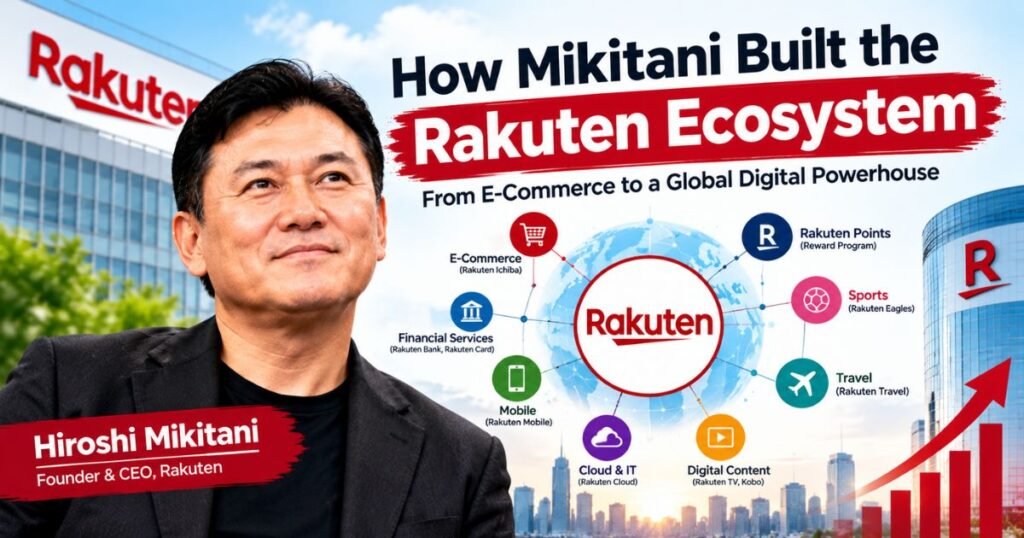
Rakuten began as an online marketplace and grew by linking many services to a single membership and points system. Its ecosystem spans e-commerce, fintech, digital content and communications. Customers who use one service are encouraged to use others.
Growth came through organic expansion and acquisitions. Over the years Rakuten acquired companies including the messaging app Viber and the e-book platform Kobo.
The biggest bet was entering mobile networks. That required heavy investment but offered a way to tie the entire ecosystem together through one connectivity layer.
Rakuten’s Current Financial Position
Rakuten reported consolidated revenue of 2.5 trillion yen for FY2025, up 9.5%, marking the 29th consecutive year of record revenue. Internet Services revenue was 1.37 trillion yen, up 6.8%, while FinTech revenue was 975.9 billion yen, up 19.0%, with FinTech non-GAAP operating income of 199.9 billion yen, up 30.3%.
The picture is not all positive. Rakuten posted a net loss attributable to owners of 177.9 billion yen for FY2025, versus a 162.4 billion yen loss the year before. IFRS operating income was 14.4 billion yen, down 72.9%, partly because 2024 included a one-off remeasurement gain of about 106.9 billion yen.
2026 has brought a turnaround. In Q1 FY2026, profit before tax reached 17.4 billion yen and Rakuten Mobile posted its first-ever first-quarter EBITDA profit. Mobile subscriptions reached 10.36 million by the end of March 2026, up 1.74 million year over year. In Q2 2026, record revenue of 665.5 billion yen came with a net profit of 227.2 billion yen, the first positive quarterly result since Q2 2020, though investors questioned its sustainability given one-off and tax effects.
| Rakuten metric | Figure |
| FY2025 revenue | ¥2.5 trillion (+9.5%) |
| FY2025 IFRS operating income | ¥14.4 billion |
| FY2025 net loss | ¥177.9 billion |
| Q1 FY2026 profit before tax | ¥17.4 billion |
| Q2 2026 revenue | ¥665.5 billion |
| Q2 2026 net profit | ¥227.2 billion |
Mikitani’s Ownership Position
Mikitani is Rakuten’s founder and a major shareholder through personal and family holding companies. In a 2021 share sale, his family’s asset management companies, Mikitani Kosan and Spirit Inc., were allotted shares alongside strategic investors. [verify the current ownership percentage in Rakuten’s latest large-shareholding report.]
Strategic investors have also entered the picture. Japan Post became the largest outside shareholder after the 2021 deal.
This structure gives Mikitani strong influence while still allowing outside capital to fund expansion, which differs greatly from Gorman’s position as a professional manager.
James Gorman and Hiroshi Mikitani: Two Leadership Models
The two men sit at opposite ends of corporate leadership. One rose through institutions and was chosen by a board, while the other built a company and still leads it.
That difference shapes risk tolerance, time horizons and how each defines success. Gorman’s success is measured partly by how smoothly he hands over, while Mikitani’s depends on how far his creation can grow.
Gorman: Institutional Transformation
Gorman changed an existing institution from within. He inherited a bank scarred by the crisis and gradually shifted its business mix through deals like the $13 billion E*TRADE acquisition and the $7 billion Eaton Vance purchase.
His approach rewarded discipline and careful handovers, from Ted Pick at Morgan Stanley to Josh D’Amaro at Disney.
Mikitani: Founder-Led Expansion
Mikitani built from scratch and kept extending the company into new fields, from online shopping to banking and mobile. His approach favored bold bets and a single connected ecosystem.
That ambition brought a ¥177.9 billion net loss in FY2025 before the 2026 turnaround. His story shows both the upside and the strain of founder-led expansion.
What They Have in Common
Both leaders have deep ties to finance and a global outlook. Each began in or near banking, and each pursued scale through major strategic moves.
Both also hold MBAs, from Columbia and Harvard respectively, and operate at the intersection of finance, technology and consumer brands.
Each has been tested by pressure, Gorman after the financial crisis and Mikitani during the mobile buildout, and each responded with a long-term plan.
Major Differences Between Gorman and Mikitani
The biggest difference is origin: Gorman was appointed to lead existing companies, while Mikitani created his own. This affects decision-making, ownership and succession.
Their sectors differ too. Gorman worked in regulated financial services and then media, whereas Mikitani runs a sprawling ecosystem mixing retail, finance and telecommunications.
| Factor | James Gorman | Hiroshi Mikitani |
| Path to the top | Professional career, board-appointed | Founded the company |
| Current role | Disney board chairman | Rakuten chairman and CEO |
| Signature deals | E*TRADE (13B),EatonVance(7B) | Mobile network buildout, Viber, Kobo |
| Succession | Pick (Morgan Stanley), D’Amaro (Disney) | Founder remains in charge |
| Key financial marker | $3.1T combined client assets after E*TRADE | ¥2.5T revenue, 29 record years |
| Main risk | Governance and execution | Debt and heavy investment |
Why the James Gorman and Hiroshi Mikitani Comparison Matters
The comparison matters because it contrasts two proven ways to lead at scale. Readers can learn from a manager who reshaped an institution and a founder who keeps building a company.
It also separates fact from speculation. There is no documented partnership between the two, but the numbers show how different strategies play out, from Morgan Stanley’s $3.1 trillion wealth platform to Rakuten’s return to quarterly profit in 2026.
The takeaway is that there is no single formula. Disciplined succession worked for Gorman, while ecosystem-wide expansion defined Mikitani, and each carries distinct strengths and risks.
Frequently Asked Questions
Are James Gorman and Hiroshi Mikitani connected?
No direct partnership, joint venture or shared board seat has been documented. The indirect link is institutional: a Morgan Stanley entity was among the international joint lead managers on Rakuten’s ¥264.9 billion global share offering in July 2023. That is a bank-client relationship, not evidence of a personal business tie.
Who is James Gorman?
He was Morgan Stanley’s CEO from January 2010 until December 2023, then executive chairman through 2024, and became chairman emeritus in January 2025. He is also chairman of The Walt Disney Company.
What is James Gorman doing at Disney?
He leads the board and oversaw the CEO search. On February 3, 2026, Disney announced Josh D’Amaro as its next CEO, taking over on March 18 and replacing Bob Iger.
Who is Hiroshi Mikitani?
He is the founder, chairman and CEO of Rakuten Group, which began in 1997 and now runs more than 70 services spanning e-commerce, fintech, digital content and communications. He holds an MBA from Harvard Business School.
Who is James Gorman’s wife?
James Gorman’s wife is Pendleton “Penny” Dedman. The couple keeps a low public profile.
Who is Hiroshi Mikitani’s wife?
Hiroshi Mikitani’s wife is Haruko Mikitani. Like Gorman, he shares little about his family in public.
How is Rakuten performing financially?
Results are improving but mixed. FY2025 revenue reached 2.5 trillion yen, up 9.5%, the 29th straight year of record revenue, yet the company posted a net loss of 177.9 billion yen. In Q2 2026 it reported a net profit of 227.2 billion yen, its first positive quarterly result since Q2 2020, though investors questioned how sustainable that profit is.
What was Gorman’s biggest deal at Morgan Stanley?
His landmark moves were in wealth management. Morgan Stanley bought ETrade in a $13 billion all-stock deal and Eaton Vance for $7 billion in cash and stock. The ETRADE combination brought total client assets to $3.1 trillion.
What is the main difference between the two leaders?
Gorman was a professional executive appointed to lead existing companies, while Mikitani is a founder-CEO who built Rakuten himself. That shapes everything from ownership and risk to how each handles succession.
Final Thoughts
James Gorman and Hiroshi Mikitani are not business partners, and no verified evidence suggests otherwise. What connects them is the contrast: two respected leaders who reached the top by opposite routes.
Gorman’s story is about disciplined transformation, from reshaping Morgan Stanley around wealth management to steering orderly successions at both the bank and Disney. Mikitani’s story is about founder-led ambition, with Rakuten’s record revenue streak, a heavy investment in mobile and a 2026 return to quarterly profit that markets are still testing.
Neither model is universally better. Stability and governance suit mature institutions, while founder vision suits companies still building something new. Read side by side, the two leaders show that lasting leadership can take more than one form.