

Joel Greenblatt vs. Jim Farley is a comparison between a value investor who studies businesses from the outside and a car executive who runs one from the inside. Greenblatt built his name at Gotham Capital and through books like The Little Book That Beats the Market. Farley, meanwhile, has led Ford Motor Company as CEO since October 2020. This guide explains who each man is, how their careers developed, and where their roles differ.
Below you will find quick facts on age, family, and net worth, along with a closer look at the Magic Formula, Greenblatt’s 13F filings, and Farley’s work on Ford quality. Some personal details, such as height, spouse, and net worth, are not confirmed by reliable public sources, so those sections are written with care. Use the headings to jump to the topic you need, or read straight through for the full comparison.
Who is Joel Greenblatt?
Joel Greenblatt is an American value investor, hedge fund manager, author, and teacher. People searching for Joel Greenblatt vs. Jim Farley are comparing two very different careers, and Greenblatt’s sits firmly in the world of investing. He is best known as the founder of Gotham Capital and a leading voice in value investing. His work shows how disciplined analysis can beat market noise.
Greenblatt studied at the Wharton School of the University of Pennsylvania, earning both his undergraduate degree and his MBA. He started Gotham Capital in 1985 with his partner Robert Goldstein, focusing on special situations such as spin-offs, restructurings, and mergers. The fund became famous for its strong long-term returns during its early years. In 1995, Gotham returned outside capital and operated privately for well over a decade.
Gotham Asset Management was later created as the successor to that business. Greenblatt also became an adjunct professor at Columbia Business School, where he taught value investing to future money managers. He helped launch Formula Investing and became a regular author on investing topics. Today he is respected as both a practitioner and an educator.
Joel Greenblatt Age
Joel Greenblatt was born on December 13, 1957, in Great Neck, New York. That makes him 68 years old as of late October 2026. His age is a common search because many readers want to know how long he has been active in markets. He has spent more than four decades in professional investing.
Greenblatt started his career in the late 1970s and early 1980s, shortly after graduating from Wharton. By his late twenties he had already launched Gotham Capital. That early start gave him decades to refine his approach to special situations. His age also reflects a long record that few investors can match.
Because he has been investing for so long, his ideas have been tested across several market cycles. He lived through the 1987 crash, the dot-com bubble, the 2008 financial crisis, and the pandemic period. His consistent focus on price versus value has stayed the same. That longevity is a major reason new investors still read his books.
Joel Greenblatt Height
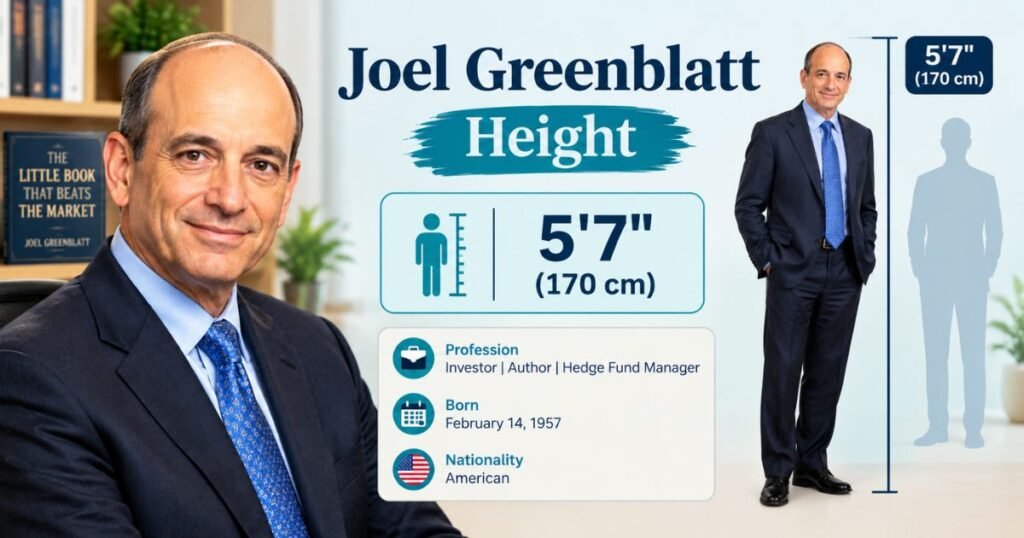
Joel Greenblatt’s height is not widely documented in reliable public sources. Unlike athletes or entertainers, fund managers rarely have official height measurements published in biographies. Many websites list guesses, but those numbers often conflict with one another. For that reason, it is safest to say his exact height has not been publicly confirmed.
Readers who search for this detail are usually curious about the person behind the investing reputation. Public profiles of Greenblatt focus on his career, his books, and his teaching rather than his physical appearance. Interviews and conference talks show him as a calm, thoughtful speaker. His influence comes from his ideas, not his stature.
If you need an accurate figure for a project, look for a direct statement from Greenblatt or an official biography. Avoid copying numbers from unverified celebrity-stat sites. Reliable information about him is far easier to find in his books and in Gotham’s published materials. It is always better to leave a detail out than to publish an unsupported claim.
Joel Greenblatt Wife
Joel Greenblatt is reported in several public biographies to be married to a woman named Julia. He has kept his family life largely private, which is common among fund managers. Because few official interviews discuss his marriage, details remain limited. Anything beyond her name should be treated with caution unless a reliable source confirms it.
Greenblatt’s public image is built around investing and teaching rather than personal publicity. He rarely shares family stories in press appearances or on social media. This privacy has helped him keep a clear line between his professional and personal lives. It also means most websites repeat the same small set of facts.
For readers who want to understand the man, his writing offers more insight than gossip. His books often mention family only in passing, usually through simple lessons about money and patience. When writing about his spouse, it is best to stick to what has been publicly reported. Respecting that privacy keeps your content accurate and trustworthy.
Joel Greenblatt Children
Public profiles commonly say that Joel Greenblatt has five children. Their names appear on some biography sites, but he has not made them a focus of his public image. Most of the available information is general rather than detailed. As with his marriage, the safest approach is to avoid unverified personal details.
Greenblatt has said in interviews and books that he values teaching and sharing knowledge. That interest extends into his philanthropic work in education, where he has supported schools and programs for young people. These efforts suggest a strong belief in opportunity through learning. They are public, documented parts of his life that readers often find inspiring.
Because his children are mostly private individuals, there is little reason to publish more than basic facts. Responsible writing avoids speculation about their careers or lives. Readers searching this topic mainly want a quick answer, which is that he is reported to be a father of five. Anything more specific belongs to the family, not to public record.
Joel Greenblatt Net Worth
Joel Greenblatt’s net worth is not officially published, and online estimates vary widely. Some sites list a few hundred million dollars, while others claim figures above one billion dollars. Because these numbers rarely cite audited records, they should be treated as rough estimates. No single figure has been confirmed by Greenblatt himself.
His wealth comes mainly from his stake in Gotham, his earlier hedge fund success, and book sales. Gotham Capital delivered high annualized returns in its early years, which built his foundation. Gotham Asset Management later grew into a large firm managing billions in client assets. It is important to separate the firm’s assets under management from his personal wealth.
When publishing this topic, state clearly that figures are estimates and name the date of the estimate. Compare multiple sources and avoid presenting any one number as fact. Readers appreciate transparency more than a bold but unsupported claim. A careful, honest range is more useful than a single headline number.
Joel Greenblatt Magic Formula
The Magic Formula is a rules-based investing strategy that Greenblatt introduced in his book The Little Book That Beats the Market. It ranks companies by two simple measures, and investors buy the highest-ranked stocks. The idea is to own good businesses when they are available at cheap prices. It turns a complex value-investing philosophy into a repeatable routine.
Investors typically screen a broad universe of stocks, often excluding financial companies and utilities. They rank each company on both measures, combine the two rankings, and select the best overall scores. The portfolio is usually held for about a year before being refreshed. This process removes much of the emotion that causes investors to chase trends.
The formula has been widely discussed, tested, and debated by researchers and individual investors. Some studies show strong results over long periods, while others find that performance varies by market and time frame. Greenblatt himself has noted that the strategy requires patience, because it can underperform for stretches. It works best for people who can stick with it through quiet years.
What does his Magic Formula measure?
The Magic Formula measures two things: earnings yield and return on capital. Earnings yield compares a company’s operating earnings, usually EBIT, with its enterprise value. A higher yield suggests the business is priced cheaply relative to what it earns. This is the “good price” half of the formula.
Return on capital measures how efficiently a company turns invested money into operating profit. Greenblatt uses EBIT divided by the sum of net working capital and net fixed assets. A high figure suggests a strong business with a durable advantage. This is the “good company” half of the formula.
Joel Greenblatt Books
Greenblatt has written several well-known books that explain investing in plain language. His first major book, You Can Be a Stock Market Genius, focuses on special situations like spin-offs and mergers. It remains popular among professional investors who want to find overlooked opportunities. The writing is witty, practical, and full of real examples.
His best-known work is The Little Book That Beats the Market, which introduced the Magic Formula to a general audience. It was written to be simple enough for a young reader yet useful for experienced investors. An updated edition followed, and the book continues to sell strongly. Many people consider it a perfect starting point for value investing.
He also wrote The Big Secret for the Small Investor, which argues that individual investors can do well with disciplined, low-cost approaches. Together, the books show his belief that clear thinking beats complexity. They also reveal his teaching style, which relies on stories and simple rules. Anyone exploring his ideas should start with these three titles.
Joel Greenblatt 13F
A 13F is a quarterly filing that large institutional investors must submit to the U.S. Securities and Exchange Commission. Gotham Asset Management, the firm Greenblatt co-leads, files these reports. They list the equity positions the firm held at the end of each quarter. Investors follow them to see how a respected manager is positioned.
Gotham’s 13F filings typically show a broad portfolio with many holdings rather than a few concentrated bets. This reflects the firm’s systematic, valuation-driven approach to selecting stocks. Readers should remember that these filings are delayed snapshots, not live trading records. They also leave out short positions and non-U.S. holdings in many cases.
When using the 13F, treat it as a research starting point rather than a buy list. Compare holdings from several quarters to see which ideas have lasted and which have changed. Check the official filings on the SEC EDGAR database for accurate data. Third-party websites can be convenient, but they sometimes contain delays or errors.
Also Like To Read This: Howard Schultz and George Soros: Careers, Politics, and Their
Who is Jim Farley?
Jim Farley is an American automotive executive and the president and CEO of Ford Motor Company. In any Joel Greenblatt vs. Jim Farley comparison, Farley represents the corporate leadership side. He has led Ford since October 2020, taking over during a period of major industry change. His work centers on vehicles, manufacturing, and the shift toward electrification.
Farley was born in Buenos Aires, Argentina, and later studied at Georgetown University. He earned his MBA from the University of California, Los Angeles. His early career was in the car industry, which shaped his product-focused leadership style. He is known for being a hands-on executive who is openly passionate about cars and racing.
Under Farley, Ford reorganized into separate business units for different parts of its operations. These include Ford Blue for combustion vehicles, Ford Model e for electric vehicles, and Ford Pro for commercial customers. The structure was designed to give each unit clearer goals and accountability. It reflects his belief that Ford must manage legacy strength and future growth at the same time.
Jim Farley Age
Jim Farley was born on June 10, 1962, which makes him 64 years old as of October 2026. He is a member of the generation that watched the auto industry move from purely mechanical machines to software-driven vehicles. That perspective informs many of his public comments on technology. His age also reflects decades of experience across several car brands.
By the time he became CEO, Farley had already spent about thirty years in the auto industry. That includes long periods at Toyota and then at Ford. He did not arrive as an outsider but as a seasoned executive who knew the business from several angles. This depth of experience is a key part of his leadership profile.
Age is a common search term for public figures, and Farley’s is easy to verify. Reliable biographies and company materials list the same birth year. Some low-quality websites show different years, so check the source before repeating a number. For accuracy, rely on established references and Ford’s official leadership pages.
Jim Farley Height
Jim Farley’s exact height is not clearly documented in trusted public sources. Ford’s official biography focuses on his career, education, and business achievements rather than physical details. Many websites list height figures, but they often disagree with one another. It is best to describe this detail as unconfirmed.
Farley appears frequently in videos, interviews, and race-day events, which leads viewers to wonder about his stature. Still, visual impressions are unreliable because of camera angles and the people standing beside him. Without an official statement, any number is just an estimate. Responsible content should not present those estimates as fact.
If you are writing about this topic, you can acknowledge that people search for it and then redirect readers to verified information. His career milestones are well documented and far more meaningful than a single measurement. Accuracy builds trust with both readers and search engines. Leaving out unverified numbers protects your credibility.
Jim Farley Career
Jim Farley began his automotive career in the early 1990s, spending many years at Toyota. During that time he worked in marketing and brand roles, including work connected to the Lexus brand. That experience taught him how customer experience can shape a car company’s reputation. It also introduced him to global operations and premium vehicle strategy.
He joined Ford in 2007 and moved through a series of senior positions. He served as head of global marketing, led Lincoln, and later ran Ford of Europe. Each role broadened his understanding of different markets, customers, and operating challenges. These assignments prepared him for the top job.
In 2020, Farley became Ford’s chief executive, succeeding Jim Hackett. He has since focused on electric vehicles, software, commercial customers, and cost discipline. His tenure has included both celebrated launches and tough challenges. Supporters praise his product passion, while critics point to quality and profitability pressures.
Jim Farley Net Worth
Jim Farley’s net worth is not publicly confirmed, and estimates differ greatly between websites. Some sources suggest tens of millions of dollars, while others claim figures well above that. Most of these numbers come from compensation data, stock holdings, and guesswork. None should be treated as an official valuation.
A more reliable way to understand his finances is to review Ford’s annual proxy statement filed with the SEC. It discloses his salary, bonuses, stock awards, and total compensation. These documents show how much of his pay depends on company performance. Executive pay in public companies is far more transparent than private wealth.
When writing about this topic, label every figure as an estimate and mention the year. Explain that his personal wealth is tied closely to Ford’s stock and long-term incentives. That connection also means his compensation can rise or fall with company results. Readers appreciate this context far more than a single, unsourced number.
Jim Farley Wife
Public sources on Jim Farley’s spouse are inconsistent, and several websites even list different names. This is a good reminder to be careful with biographical claims from low-quality pages. Farley has not made his marriage a regular part of his public image. Ford’s official materials focus on his professional record instead.
He has occasionally spoken about family in interviews, usually in relation to work ethic and practical skills. These remarks are brief and do not provide a full picture of his home life. Because the details are sparse, it is wise not to repeat a name unless it is confirmed by a trustworthy source. Privacy is respected for most executives outside the spotlight.
If you want to include this section, keep it short and factual. State that he is married with children if reputable reporting supports it, and avoid extra speculation. Direct readers to official biographies for confirmed information. This approach keeps your article accurate and respectful.
Jim Farley Ford Quality Control

Quality control has become one of the most discussed topics in Farley’s time as CEO. Ford has faced a large number of recalls and warranty costs in recent years. Farley has said publicly that improving quality is a top priority and has described the problem as unacceptable. His comments show that he treats it as a central leadership issue.
Ford has responded by changing how it manages engineering, suppliers, and launch readiness. The company has said it wants to catch defects earlier and reduce repeat problems. Reported recall counts across the industry have also drawn attention to how complex modern vehicles have become. Software, electronics, and new technology add many new points of possible failure.
Whether these efforts succeed will take time to judge. Investors, customers, and regulators will watch recall data, warranty costs, and customer satisfaction scores. For readers, the key point is that quality is both a reputation issue and a financial one. Farley’s legacy will likely depend on how well Ford solves it.
Jimmy Farley Sunglasses
Many people searching “Jimmy Farley sunglasses” are likely looking for a style detail they saw in a photo or video. There is no widely confirmed, official brand or model tied to Jim Farley in Ford’s public materials. Online guesses about a specific pair should be treated with caution. Without a verified source, it is best not to name a brand.
Farley is often seen at racing events, product launches, and outdoor media appearances, where sunglasses are common. In those settings, practical sport-style eyewear is typical for many executives and drivers. That visual style fits his enthusiasm for cars and motorsport. It does not, however, point to any single product.
If you are writing a product guide, focus on general styles rather than claiming a specific pair. You can suggest sport wraparounds or classic aviators as common choices among car enthusiasts. Be clear that this is style guidance, not a confirmed fact about him. Honest wording avoids misleading readers who want a real answer.
Ford CEO Jim Farley
As Ford’s CEO, Jim Farley is responsible for the company’s overall strategy, products, and financial performance. He reports to the board, which is chaired by Bill Ford. His role includes managing manufacturing, brand direction, technology investments, and relationships with workers and regulators. These responsibilities make him one of the most visible leaders in American industry.
Farley is known for a direct and energetic communication style. He often speaks openly about Ford’s strengths and weaknesses, including costs, competition, and quality. He has also been a vocal advocate for skilled trades, urging more young people to consider technical careers. That message has helped shape his public voice beyond the company itself.
His tenure has coincided with some of the biggest changes in the car business. These include electrification, software-defined vehicles, new competitors, and shifting government policy. Ford has had notable successes, such as strong truck and commercial vehicle demand. It has also faced losses and delays in its electric vehicle plans.
How did Farley’s Ford career develop?
Farley joined Ford in 2007 after years at Toyota, starting in a senior marketing role. He then took on Lincoln, where he worked to refresh the luxury brand and its customer experience. Later he ran Ford of Europe, gaining experience in a complex and competitive region. These steps gave him a broad view of the company.
In 2020, he moved into the CEO role and quickly began reorganizing the business. He pushed Ford toward electric vehicles such as the Mustang Mach-E and F-150 Lightning while protecting its profitable truck lineup. He also emphasized commercial customers through Ford Pro. His career shows a steady rise from marketing leader to chief executive.
How do their professional responsibilities compare?
In a Joel Greenblatt vs. Jim Farley comparison, the biggest difference is the nature of their work. Greenblatt allocates capital, analyzing businesses and deciding which stocks are worth owning. Farley runs one specific company, directing engineers, factories, and employees. One studies many companies from the outside, while the other leads one from the inside.
Their measures of success also differ. Greenblatt is judged by investment returns, the quality of his research, and the usefulness of his teaching and books. Farley is judged by vehicle quality, sales, profitability, and Ford’s competitive position. Both roles require discipline, but they apply it in very different ways.
Interestingly, their worlds can overlap. An investor using Greenblatt’s methods might analyze Ford’s earnings yield and return on capital, while Farley’s decisions affect those very numbers. Greenblatt looks at price versus value, and Farley works to build that value. Together, they show two sides of the same business world.
Sources:
- Wikipedia: Joel Greenblatt (https://en.wikipedia.org/wiki/Joel_Greenblatt)
- Wikipedia: Jim Farley (businessman) (https://en.wikipedia.org/wiki/Jim_Farley_(businessman))
- SEC EDGAR: Gotham Asset Management 13F filings (sec.gov)
- Ford Motor Company: Corporate leadership profile and annual proxy statement (corporate.ford.com)
- Columbia Business School faculty profile
- Joel Greenblatt, The Little Book That Beats the Market; You Can Be a Stock Market Genius; The Big Secret for the Small Investor
FAQs
Who is older, Joel Greenblatt or Jim Farley?
Joel Greenblatt is older. He was born on December 13, 1957, while Jim Farley was born on June 10, 1962. That is a gap of roughly four and a half years. As of October 2026, Greenblatt is 68 and Farley is 64.
What is Joel Greenblatt best known for?
Greenblatt is best known for founding Gotham Capital and for creating the Magic Formula. He is also an author and a former adjunct professor at Columbia Business School. His most popular book is The Little Book That Beats the Market.
What does Jim Farley do at Ford?
Farley is the president and CEO of Ford Motor Company, a role he has held since October 2020. He oversees strategy, products, manufacturing, and financial results. He also leads Ford’s push into electric vehicles, software, and commercial customers through Ford Pro.
Are the net worth figures for Greenblatt and Farley confirmed?
No. Neither man has published an official net worth, and online estimates vary widely. For Farley, Ford’s annual proxy statement shows his compensation, which is a more reliable starting point. For Greenblatt, any figure should be treated as a rough estimate.
Where can I find Joel Greenblatt’s 13F filings?
Gotham Asset Management’s 13F filings are public on the SEC EDGAR database. Search for the firm by name and open its latest quarterly report. Remember that a 13F is a delayed snapshot of long equity positions, not a live record of trading.
Do Joel Greenblatt and Jim Farley have a direct connection?
There is no known direct professional partnership between them. They appear together in searches because they are both prominent figures in business, but in very different fields. One analyzes companies as an investor, and the other runs a major automaker.
Conclusion
Joel Greenblatt and Jim Farley show two very different paths to influence in the business world. Greenblatt built his reputation by finding good companies at fair prices, teaching others how to do the same, and writing clear books on investing. Farley built his by rising through marketing and leadership roles at Toyota and Ford before becoming CEO. One allocates capital across many companies, while the other is responsible for the results of one.
For readers, the takeaway is that the two roles complement each other. An investor using Greenblatt’s ideas could study Ford’s earnings and return on capital, while Farley’s decisions on quality, electric vehicles, and costs shape those numbers. Keep in mind that several personal details, including net worth, family, and height, are unconfirmed, so rely on official filings and trusted biographies for anything you plan to publish.