
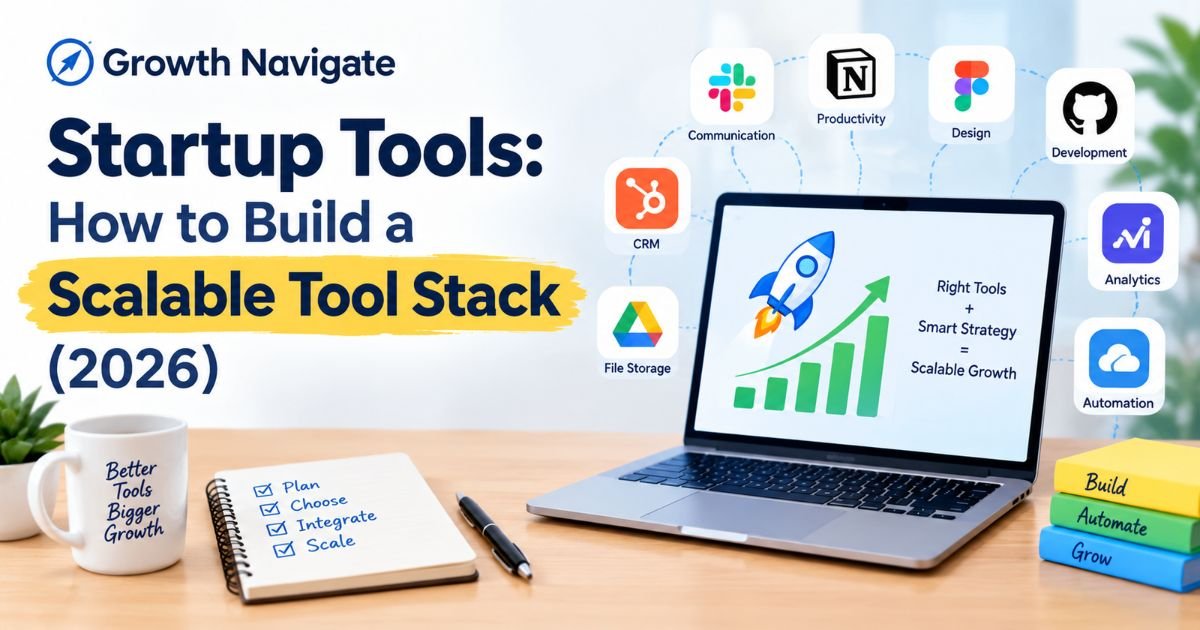
Growth Navigate Startup Tools decide how fast a young company can learn, sell, and scale. A founder with the right software sees leads, revenue, and product usage in one place. A founder with the wrong software spends evenings copying numbers between spreadsheets and guessing what is working. In 2026, that difference often separates startups that grow steadily from those that stall.
The challenge is not a shortage of options. Thousands of apps promise faster growth, and most offer free trials, polished demos, and glowing reviews. That abundance makes it easy to overspend, overbuild, and end up with a stack nobody fully understands. Smart founders pick tools by the job they need done, not by hype or by what a bigger company uses.
This guide walks you through the full picture. You will learn what these tools are, which categories matter, and how ten popular options compare. You will also see how to build a stack by stage, estimate real costs, track the right metrics, and audit your tools every quarter. Use it as a practical roadmap for building a stack that scales with you.
What Growth Navigate Startup Tools Really Are
Growth Navigate Startup Tools are the software products a young company uses to find customers, manage work, measure results, and make better decisions as it scales. The phrase does not point to one product. It describes a connected set of apps that help founders move from a rough idea to a repeatable business without wasting money or time on guesswork.
Most founders picture a tool as a single app that solves a single problem. In practice, the value comes from how tools talk to each other. A CRM that pulls in website leads, an analytics platform that reads product usage, and a billing system that updates revenue figures automatically all form a stack. Each piece is useful alone, but together they give a clear picture of the business.
The word “navigate” matters here. Early-stage startups operate with limited data, limited staff, and limited runway, so they need instruments that show direction. Good tools answer practical questions such as where leads come from, which features people use, and which customers are likely to leave. When a tool cannot answer a question you actually ask each week, it is clutter rather than a growth tool.
Why the Right Tools Matter So Much
The right tools save the one resource startups cannot buy back: time. A three-person team that automates invoicing, lead capture, and reporting can spend those hours on product and sales. A team doing all of it by hand burns the same hours on repetitive tasks, and that gap compounds every month. Over a year, the difference often decides who reaches product-market fit first.
Tools also shape decisions. When your data lives in scattered spreadsheets, every meeting turns into an argument about whose numbers are correct. A shared dashboard removes that friction, so the team can debate strategy instead of arithmetic. Investors notice this as well, because clean reporting signals discipline and makes due diligence far easier when fundraising begins.
The wrong tools do real damage, though. Overbuilt platforms demand setup time, training, and monthly fees that early teams cannot justify. Underbuilt tools force migrations later, which are painful once data has piled up. The goal is not to own the most software. The goal is to own the smallest set of tools that removes your current bottleneck and can grow with you.
The Core Categories Every Startup Stack Needs
Every startup stack rests on a handful of categories, no matter the industry. These include communication and project management, customer relationship management, analytics, marketing and email, and finance. Covering these five areas gives a small team the visibility and workflow it needs to operate. Anything beyond them should be added only when a specific problem justifies the cost.
Communication and project tools keep work visible so nothing depends on one person’s memory. CRM tools store every lead, conversation, and deal in one place, which prevents revenue from slipping through cracks. Analytics tools turn raw activity into numbers you can act on. Marketing tools carry your message to the right audience, while finance tools keep cash, invoices, and taxes under control.
Think of these categories as layers rather than a shopping list. Start with the layer that hurts most today, then add the next one when it becomes the bottleneck. A founder who sells through email may need a CRM before anything else. A product-led startup may need analytics first. The order depends on how your business actually earns its first dollars.
The Best Growth Navigate Startup Tools by Job
Choosing by job is more reliable than choosing by brand. Ask what you need the tool to do, then compare options built for that task. For project management, Notion, Asana, and Trello cover most small teams. For sales tracking, HubSpot CRM and Pipedrive are common picks. For product analytics, Mixpanel and Google Analytics handle most early-stage needs.
For marketing, Mailchimp, Brevo, and Canva help founders run campaigns without a dedicated designer or developer. For payments and billing, Stripe is widely used because it connects easily to other software. For automation, Zapier and Make link apps together so data moves without manual copying. Each of these tools has a free or low-cost entry plan, which lets you test before committing.
The table below groups these options by the job they perform, so you can match a tool to a real need quickly.
| Job | Example Tools | Best For |
| Project management | Notion, Asana, Trello | Task tracking and team planning |
| Sales and CRM | HubSpot, Pipedrive | Lead and deal tracking |
| Product analytics | Mixpanel, Google Analytics | Understanding user behavior |
| Email and marketing | Mailchimp, Brevo | Campaigns and newsletters |
| Payments | Stripe | Billing and subscriptions |
| Automation | Zapier, Make | Connecting apps without code |
What Are Growth Navigate Startup Tools?
Put simply, these are the apps and platforms that help a startup grow in a measured, trackable way. They cover the full path from attracting a visitor to keeping a paying customer. Some focus on getting attention, others on converting interest into revenue, and others on keeping the operation organized as the team expands.
What separates a growth tool from an ordinary business tool is its link to measurable outcomes. A growth tool lets you see whether a change helped or hurt. When you adjust a landing page, send a new email sequence, or change pricing, the right platform shows the effect within days. That feedback loop is what allows small teams to learn faster than larger, slower competitors.
You do not need every category at once. Many successful startups began with a spreadsheet, a shared inbox, and a payment processor. They added tools only when manual work became too slow or too error-prone. Treat the definition as flexible: a growth tool is whatever helps your team learn, act, and measure with less effort than before.
Also Like To Read This: AdsTotally.com Explained: Features, Purpose, Content & How It Works
Quick Comparison: 10 Best Growth Navigate Startup Tools in 2026
Comparing tools side by side makes the decision less overwhelming. The table below summarizes ten widely used options across the main categories, with their strongest use case and a general pricing idea. Plans and prices change often, so check each vendor’s website for current figures before you buy.
| Tool | Category | Best For | Pricing Style |
| Notion | Workspace | Docs, wikis, planning | Free tier, paid per user |
| HubSpot | CRM and marketing | Lead tracking | Free tier, paid upgrades |
| Slack | Communication | Team chat | Free tier, paid per user |
| Mixpanel | Product analytics | User behavior | Free tier, usage-based |
| Google Analytics | Web analytics | Traffic insights | Free |
| Stripe | Payments | Online billing | Per-transaction fees |
| Zapier | Automation | App integrations | Free tier, paid by tasks |
| Mailchimp | Email marketing | Campaigns | Free tier, paid by contacts |
| Canva | Design | Marketing visuals | Free tier, paid per user |
| Airtable | Database | Custom workflows | Free tier, paid per user |
Notice that nearly all of them offer a free entry point. That makes testing cheap and reversible. The real expense appears later, in setup time and in the effort of moving data between systems. Judge each tool on how well it integrates with the others in your stack, not only on its own feature list.
Use the table as a starting shortlist rather than a final verdict. A tool that suits a software startup may not suit a local services business. Pick two candidates per category, run each through a short trial with real data, and keep the one your team actually enjoys using. Adoption matters more than features.
10 Best Growth Navigate Startup Tools for 2026

Notion, Slack, and HubSpot form a strong foundation for organization and sales. Notion works as a shared workspace for documents, roadmaps, and meeting notes, and it replaces several smaller apps. Slack keeps conversations searchable and organized by topic. HubSpot offers a free CRM that records contacts and deals, which is often enough for a team in its first year.
Mixpanel, Google Analytics, and Stripe give you the numbers. Mixpanel tracks what users do inside your product, such as which features they try and where they drop off. Google Analytics shows how visitors reach your site and what they do there. Stripe handles payments and subscriptions, and its data tells you exactly how much revenue you earn and from whom.
Zapier, Mailchimp, Canva, and Airtable help you move faster. Zapier connects your apps so a new lead can trigger an email, a task, and a CRM entry automatically. Mailchimp manages newsletters and simple campaigns. Canva lets non-designers produce professional visuals. Airtable combines a spreadsheet with a database, which suits custom workflows that off-the-shelf tools do not cover.
How to Build a Startup Growth Stack That Actually Works
A working stack begins with a problem, not a product. Write down the three tasks that consume the most team time or cause the most errors each week. Then search for tools that solve those exact tasks. This approach prevents the common habit of adopting popular software without a clear purpose, which leaves teams paying for features nobody uses.
Next, plan for integration from the start. Before choosing a tool, check whether it connects to the software you already own, either natively or through a connector like Zapier. Data that flows automatically between apps reduces manual work and mistakes. Tools that trap your data inside a closed system create hidden costs, because switching later becomes slow and risky.
Finally, assign ownership. Every tool needs one person responsible for setup, training, and upkeep. Without an owner, accounts multiply, permissions become messy, and data quality slips. Keep a simple document listing each tool, its purpose, its owner, and its renewal date. That small habit keeps the stack healthy as the team and the business grow.
Why Most Founders Build Their Stack Wrong
The most common mistake is buying too much too early. Founders see polished demos, read glowing reviews, and sign up for enterprise-grade platforms before they have a single repeatable sales process. The result is a stack full of half-configured tools, each charging a monthly fee while delivering little value. Complexity arrives long before the scale that would justify it.
Another frequent error is copying another company’s stack. A tool that works brilliantly for a funded team of fifty may overwhelm a team of three. Your customers, sales cycle, and budget are different, so your tools should be different too. Borrow ideas for categories, but test every individual choice against your own workflow.
A third problem is neglecting data hygiene. Teams add tools without deciding where the single source of truth lives, so customer details end up in four places with four versions. Reports then disagree, and trust in the numbers erodes. Decide early which system owns which data, and make every other tool read from it rather than keep its own copy.
FAQs
What are Growth Navigate Startup Tools?
They are the software products a startup uses to attract customers, manage work, track results, and scale with less manual effort. The term covers a connected stack rather than one app. It typically includes tools for collaboration, CRM, analytics, marketing, and finance.
How many tools does an early-stage startup really need?
Most early teams can start with five to seven tools, one per core category. A workspace, a CRM, analytics, an email platform, and a payment processor already cover the basics. Add more only when a specific bottleneck justifies the cost.
How much should a startup spend on tools each month?
A validation-stage team often spends under $100 a month, while a team with early traction may spend a few hundred dollars. Costs rise with seats, contacts, and usage, so review spending against revenue regularly. Prices vary by vendor, so check current plans before buying.
How often should I audit my startup tool stack?
A quarterly audit works well for most teams. List every subscription, check actual usage, remove overlap, and confirm permissions and integrations. This short habit prevents wasted spending and keeps data clean.
Should I choose all-in-one platforms or separate specialized tools?
It depends on your stage and team. All-in-one platforms reduce setup and keep data together, which suits very small teams. Specialized tools offer deeper features and flexibility, which suits growing teams, provided they integrate well with the rest of your stack.
Conclusion
The best Growth Navigate Startup Tools are the ones that solve a real problem today and can grow with you tomorrow. Start with the five core categories, choose by job rather than brand, and add tools only when a bottleneck appears. A lean, well-connected stack beats a large, neglected one every time.
Cost and discipline matter as much as features. Count setup time and per-seat growth, keep a single source of truth for your data, and assign an owner to every tool. Track a small set of metrics tied to your current goal so your tools produce decisions rather than noise.
Finally, treat your stack as a living system. Review it every quarter, retire what you no longer use, and upgrade only when you have clearly outgrown a tool. Founders who build this habit spend less, move faster, and enter each new stage with a stack that supports their growth instead of slowing it down.
[…] Also Read This: Growth Navigate Startup Tools: How to Build a Scalable Tool Stack […]