
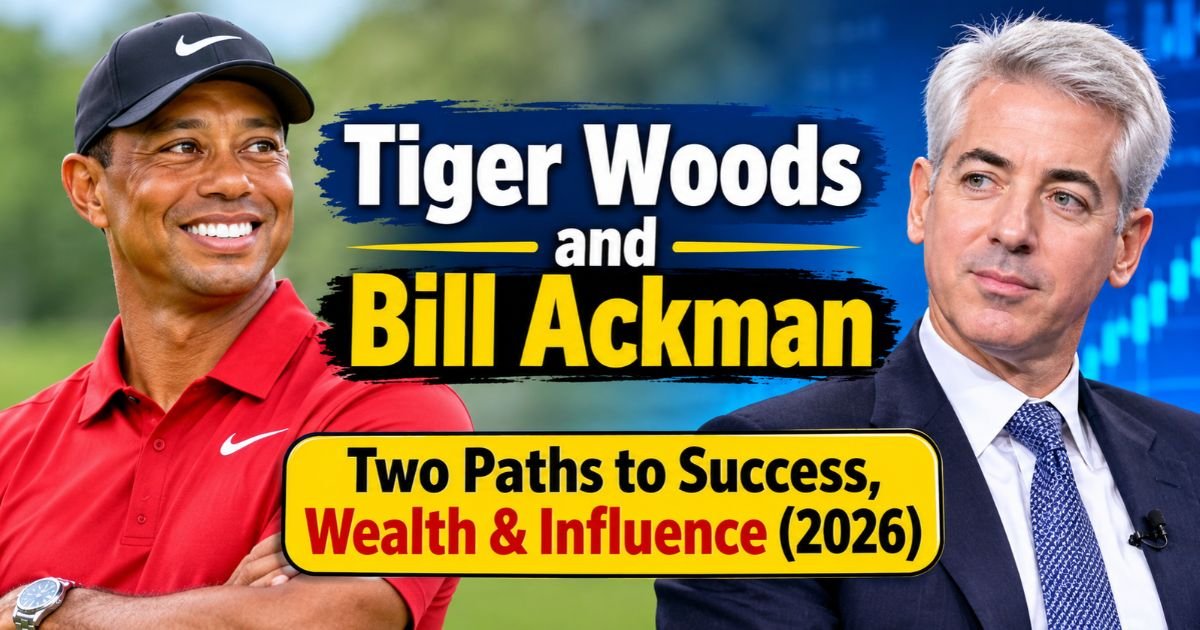
Tiger Woods and Bill Ackman come from completely different worlds, yet both reached the top of their fields and built enormous public followings. Woods became the defining golfer of his generation, while Ackman became one of the most visible hedge fund managers on Wall Street. Readers often search for them together because both names stand for wealth, discipline, and influence.
This guide covers the personal background of each man, including age, parents, family, and net worth. It then looks at how each built a career, managed risk, and used fame to gain a wider platform. A few comparison tables make the key numbers and contrasts easy to scan.
The two men are not business partners, and there is no documented close link between them. The value of putting them side by side is the contrast: one path runs through athletic talent and brand building, the other through capital and conviction. By the end, you will see what each career can teach about success in 2026.
Tiger Woods age

Tiger Woods was born on December 30, 1975, in Cypress, California. That makes him 50 years old in 2026, and he has spent more than three decades in the public eye. Few athletes have stayed relevant for so long, and fewer still have done it while recovering from repeated injuries.
His age matters because it frames how his career is judged today. Golfers in their fifties usually move to the senior tour or into course design and commentary. Woods is a rare case. He remains an active competitor when his body allows and a global brand at the same time.
Fans still ask whether he can win again at this age. His recent seasons have been shaped by surgeries, limited schedules, and carefully chosen starts. Even so, his appearances draw enormous crowds and television audiences. His age adds to the aura around his comebacks rather than reducing it.
Tiger Woods’ parents
Tiger’s parents, Earl and Kultida Woods, shaped both his character and his game. Earl was a retired U.S. Army officer and Vietnam veteran. He introduced his son to golf when Tiger was still a toddler and became his first coach. Earl died in May 2006, a loss Tiger has often described as one of the hardest of his life.
Kultida, who is originally from Thailand, gave Tiger his Buddhist-influenced upbringing. She emphasized discipline, respect, and mental calm. Tiger has often credited her with the emotional steadiness he shows under pressure. Her influence is easy to miss next to his father’s very public role, but it is central to who he became.
The couple’s different backgrounds also gave Tiger a multicultural identity that became part of his public story. His father was African American, with some Native American and Chinese ancestry, and his mother is Thai. That heritage made him a symbol for many communities who had rarely seen themselves at the top of golf. It also changed how the sport was marketed globally.
Tiger Woods wife
Tiger Woods married Swedish former model Elin Nordegren in October 2004 in Barbados. The two had met a few years earlier through mutual friends on the professional golf circuit. They had two children, a daughter named Sam and a son named Charlie. The marriage ended in divorce in 2010 after a highly publicized scandal.
Since then, Woods has kept his private life far more guarded. He co-parents his children with Nordegren and has described that relationship as cooperative. Both children have appeared at his tournaments, and Charlie has become a promising junior golfer. Woods has called playing alongside his son one of the greatest joys of his later career.
Woods is not currently married. Media reports in 2025 linked him to Vanessa Trump, though details about any relationship should be checked against current reporting. As a rule, he shares little about his romantic life. That privacy is a deliberate contrast to the intense scrutiny of his earlier years.
Tiger Woods young
Tiger’s talent appeared almost before he could walk. He putted against comedian Bob Hope on national television as a toddler. At age two he appeared on a talk show to show off his swing. By his teens he was already treated as a once-in-a-generation prospect.
His amateur record is remarkable. He won three consecutive U.S. Junior Amateur titles from 1991 to 1993. He then won three straight U.S. Amateur championships from 1994 to 1996, a feat no one had managed before. He attended Stanford University, where he was a standout on the golf team.
Woods turned professional in August 1996, and the impact was immediate. He won the 1997 Masters at age 21 by a record twelve strokes. That victory changed golf’s audience, prize money, and sponsorship landscape almost overnight. It marked the start of an era many still call the Tiger effect.
Also Like To Read This: Who Is Vivian Jenna Wilson? Biography, Family, Education & Life
Tiger Woods net worth
Tiger Woods’s net worth is estimated at around $1.3 billion, which places him among the wealthiest athletes in history. He was the first athlete to be widely reported as a billionaire. Most of that wealth comes from endorsements rather than tournament prize money. His on-course earnings are large, but they are only a fraction of his total.
His biggest endorsement partner for decades was Nike, a relationship that began when he turned pro. Over time he added deals with companies across the automotive, technology, and consumer goods sectors. Those partnerships made him one of the first athletes whose earnings off the course far exceeded his winnings. His brand value stayed high even through personal and legal troubles.
Today his income also comes from business ventures such as TGR Ventures, his golf course design work, and his apparel line. The table below summarizes the main sources.
| Income source | Description |
| Prize money | Over $120 million in PGA Tour career earnings |
| Endorsements | Long-term deals with major global brands |
| Apparel | Sun Day Red, launched in partnership with TaylorMade |
| Course design | TGR Design projects worldwide |
| Media and tech | TGL league and related ventures |
Tiger Woods: A Revolutionary Figure in Golf
Tiger Woods changed professional golf in ways that go beyond his trophy count. He won 15 major championships and 82 PGA Tour events, a total that ties the all-time record. He held the world number one ranking for a record number of weeks. His dominance in the early 2000s, including four majors in a row, remains one of the great runs in sport.
His influence extended to how players train. Woods made fitness, nutrition, and strength work a standard part of a golfer’s routine. Before him, many professionals treated golf as a skill sport with little need for athletic conditioning. Today’s younger stars, many of whom grew up watching him, follow the model he helped create.
He also transformed the sport’s economics. Television ratings jumped when he was in contention, and prize funds grew dramatically during his peak years. Sponsors, broadcasters, and tournament organizers all benefited from the audience he attracted. Golf became more diverse and more global as a result.
The Business Career of Tiger Woods
Woods built his business career around a mix of endorsements, equity-style ventures, and brand ownership. Early on, his management team focused on a small number of premium partnerships rather than hundreds of deals. That kept his image exclusive and his earning power high. It also gave him leverage to negotiate better terms over time.
Over the years he moved from being a spokesperson to being a founder. TGR Design now works on golf courses and related projects. The TGR Foundation supports education programs for students. These ventures gave him roles that continue well beyond his playing days.
More recently he co-founded TGL, a technology-driven indoor golf league, and launched the Sun Day Red apparel brand. These projects show an effort to shape the future of the sport rather than simply benefit from it. They also reflect a broader strategy of owning assets instead of renting his name. That shift is similar in spirit to how investors think about long-term value.
Tiger Woods and Brand Building
Tiger Woods’s brand was built on a clear and consistent image: relentless, composed, and focused on winning. The red shirt on Sunday and the fist pump became instantly recognizable symbols. Marketers could rely on a simple message, and it made his name valuable everywhere. Few athletes have matched that level of brand clarity.
His brand also proved resilient. After the 2009 scandal and later injuries, many analysts expected his commercial value to collapse. Instead, his return to winning, especially the 2019 Masters, revived public affection. The comeback story became part of the brand itself.
Sun Day Red shows how he now wants to control that brand directly. The line uses his Sunday-red identity and his famous logo, and it competes in a crowded apparel market. Success is not guaranteed, but the move marks a clear step from endorsement to ownership. It is a useful case study for anyone interested in personal branding.
Bill Ackman Age
Bill Ackman was born on May 11, 1966, which makes him 60 years old in 2026. He has spent more than three decades in finance. His age places him in a generation of investors who built firms in the 1990s and 2000s and are now in a later, more public chapter.
His career timeline helps explain his current position. He founded his first investment firm in the early 1990s, launched Pershing Square in 2004, and has since managed billions of dollars. A long track record lets him run concentrated portfolios with great confidence. That experience also feeds his willingness to take public positions that other managers avoid.
At 60, Ackman shows no signs of slowing down. He remains active as CEO of Pershing Square and posts frequently on social media. He has also talked about growing the firm’s structure and public profile. For many followers, his age is part of the appeal because he combines experience with an energetic public presence.
Bill Ackman Parents

Bill Ackman grew up in Chappaqua, New York, in a family with deep roots in commercial real estate finance. His father, Lawrence Ackman, was a well-known figure in that industry and helped build a real estate finance firm. His mother, Ronnie Ackman, was an active presence in the family. This environment gave Bill an early view of deals, risk, and negotiation.
He has often spoken about his father’s influence on how he thinks about business. Real estate finance taught him to look at cash flow, leverage, and downside protection. Those habits later became central to his investing approach. He has also described early lessons about persistence after setbacks in the family business.
His upbringing was comfortable but also instilled a strong work ethic. He went on to Harvard University, where he earned his undergraduate degree and later an MBA. Family connections may have opened some doors, but he built his own firm from the ground up. His story is often cited as an example of how early exposure shapes later ambition.
bill ackman height
Bill Ackman’s height is a common search topic, but there is no official figure from him or his firm. Public estimates generally put him somewhere around 5 feet 10 inches, though sources vary. Because it is not formally confirmed, readers should treat any exact number as an approximation.
Height rarely matters in his line of work, where influence comes from analysis, capital, and communication. His public image is built on presentations, interviews, and written posts rather than physical presence. Still, interest in details like height shows how closely people follow prominent investors. Fans often compare public figures in photos and videos.
If you are writing about this topic, it is best to say that height is estimated rather than verified. Adding a reliable source link protects credibility. This approach also helps search visibility, since readers trust pages that are careful with facts. Accuracy matters more than a precise-sounding number.
bill ackman daughter
Bill Ackman is a father of daughters, and he has occasionally mentioned his family in interviews and on social media. He has two older daughters from his first marriage, which ended in 2016. He later married architect and designer Neri Oxman in 2019. Reports indicate the couple also have young children together.
Ackman has generally kept his children’s names and details out of the spotlight, and that is worth respecting in any article. He sometimes shares family moments in broad terms but does not publish extensive personal information about them. That balance matches the privacy most high-profile parents try to maintain. It also keeps coverage focused on public matters.
Fatherhood is one theme he returns to when talking about values and long-term thinking. He has said family perspective influences how he thinks about legacy and responsibility. For readers, this adds a human layer to a figure usually described through numbers and market positions. It is best covered briefly and respectfully.
bill ackman net worth
Bill Ackman’s net worth is commonly estimated at roughly $9 billion, according to major wealth trackers, though the number moves with markets. Most of his wealth comes from his stake in Pershing Square and from the performance of its investments. When the firm’s holdings rise, his personal fortune rises too. That makes his wealth more volatile than a salary-based income.
His fortune has been built through concentrated bets that have paid off over time. A well-known example is the hedge he placed in early 2020, which produced very large returns as markets fell during the pandemic. He has also made large gains from positions in companies such as Chipotle and Canadian Pacific. These successes helped establish his reputation.
The table below compares the two men’s wealth profiles at a glance.
| Tiger Woods | Bill Ackman | |
| Estimated net worth | About $1.3 billion | About $9 billion |
| Main source | Endorsements and business ventures | Investment management (Pershing Square) |
| Wealth type | Brand and licensing driven | Capital and equity driven |
| Volatility | Moderate, tied to brand and play | Higher, tied to markets |
Bill Ackman: A Different Route to Prominence
Where Tiger Woods rose through sport, Bill Ackman rose through finance. He earned degrees at Harvard and then launched his own investment firm at a young age. His early years were not smooth, and he faced setbacks that nearly ended his first venture. Those experiences shaped his later caution and conviction.
He gained wider fame through very public investment campaigns. Instead of quietly holding stocks, he argued his case in presentations, interviews, and letters. This transparency made him a recognizable name outside Wall Street. It also invited both praise and criticism.
His path shows that prominence can come from ideas as much as results. Ackman built a platform by explaining his reasoning clearly and defending it under pressure. That approach contrasts sharply with the quiet, secretive style of many hedge fund managers. It is a key reason he is better known than most of his peers.
Pershing Square and Activist Investing
Pershing Square Capital Management, founded in 2004, is the firm at the center of Ackman’s career. It follows a concentrated approach, holding a small number of large positions in high-quality companies. The firm often takes a significant stake and then pushes for changes it believes will unlock value. That style is known as activist investing.
Some of his campaigns became famous. His battle over Herbalife, in which he took a large short position, drew national attention and lasted for years. He also pressed for changes at companies like Canadian Pacific and Wendy’s. Results have varied, and not every campaign succeeded, which is part of the story.
Pershing Square also operates a publicly traded vehicle, which gives retail investors access to the strategy. This structure helped broaden its reach beyond institutional clients. Supporters see it as a transparent and long-term approach, while critics point to the risks of concentration. Either way, it remains one of the most closely watched funds in the industry.
Risk, Discipline, and Decision-Making
Both men are known for performing under pressure, though in different arenas. Woods relies on physical skill, preparation, and mental composure over four rounds. Ackman relies on research, valuation, and conviction over years. Each has built a process that helps them stay steady when outcomes are uncertain.
Ackman’s style involves taking large, concentrated risks after deep analysis. He often says he prefers a few strong ideas over a wide, diversified spread. That makes his results more dramatic in both directions. His discipline lies in holding firm to a thesis while still watching for signs he may be wrong.
Woods managed risk differently, planning each tournament around peak performance and course strategy. He accepted that major championships demanded calculated aggression at key moments. Both men also learned from public failures and returned with adjusted approaches. The shared lesson is that good decision-making combines preparation, patience, and the nerve to act.
Public Influence Beyond Their Professions
Woods’s influence reaches far beyond golf. He is a cultural figure whose comebacks are covered as national news. His foundation supports education, and his presence has helped bring new fans and players into the sport. Young athletes in many sports cite him as an inspiration.
Ackman’s influence comes largely through media and social platforms. He shares opinions on business, politics, and public issues, often at length and with strong views. Those posts reach millions and can shift discussions or markets. Supporters value his candor, while critics argue he should be more restrained.
Both men show how success can open a larger public role. Their platforms carry responsibility, since statements and actions are widely amplified. Readers should evaluate each figure’s views independently and rely on verified reporting. What they share is the ability to shape conversations well outside their original fields.
Tiger Woods and Bill Ackman: Key Differences
The most obvious difference is the field each chose. Woods built a career on athletic performance and then expanded into business. Ackman built his on analysis and capital, then expanded into public commentary. One path starts with a physical gift, the other with intellectual and financial skill.
Their sources of wealth also differ. Woods’s fortune relies heavily on brand value, while Ackman’s depends on the performance of invested capital. Their public images differ too: Woods is private and image-controlled, while Ackman is outspoken and highly visible online. The table below summarizes the contrast.
| Category | Tiger Woods | Bill Ackman |
| Field | Professional golf | Investment management |
| Rise to fame | Child prodigy, early pro success | Built a firm, public campaigns |
| Wealth source | Endorsements, business ventures | Pershing Square stake and returns |
| Public style | Reserved, tightly managed | Outspoken, very active online |
| Approach to risk | Calculated, performance-driven | Concentrated, research-driven |
| Legacy focus | Sport, brand, foundation | Fund, activism, public commentary |
Their Limited Connection
There is no well-documented business partnership or close public relationship between Tiger Woods and Bill Ackman. They are usually grouped together because both are famous, wealthy, and influential, not because they work together. Articles that pair them are comparing careers rather than reporting a shared project.
That said, they move in overlapping circles of high-profile business and sports figures. Events, charity functions, and golf-related gatherings sometimes bring such people together. Any claim of a deeper link should be backed by a clear source. Without one, it is wiser to describe the connection as limited or unconfirmed.
For readers, the value of the comparison is in the contrast rather than a link. Putting two very different success stories side by side highlights common traits like persistence and strong decision-making. It also shows that wealth and influence can be reached by many routes. The comparison works best as an analysis of lessons, not as a claim of association.
Lessons From Two Very Different Careers
The first lesson is that preparation and focus matter in every field. Woods practiced relentlessly from childhood, and Ackman studied companies deeply before committing capital. Neither success was accidental, even if talent played a part. Consistent effort over many years is the thread that connects them.
The second lesson is resilience. Woods returned from scandal, injuries, and surgeries to win again, while Ackman recovered from early financial setbacks and failed campaigns. Both show that public failure does not have to be permanent. What counts is how a person responds, adapts, and keeps working.
The third lesson is to build assets beyond your main skill. Woods moved from playing to owning brands and ventures, and Ackman moved from managing money to shaping public debate. Each widened their influence over time. For readers, the takeaway is to turn a core strength into something that lasts beyond a single career phase.
FAQs
How old are Tiger Woods and Bill Ackman in 2026?
Tiger Woods was born on December 30, 1975, so he is 50 years old in 2026. He has been a public figure since childhood and a professional since 1996. That long timeline is part of why his comebacks draw so much attention.
Bill Ackman was born on May 11, 1966, which makes him 60 in 2026. He launched Pershing Square in 2004 and remains its CEO. Both men are still active in their fields, though in very different ways.
Who is richer, Tiger Woods or Bill Ackman?
Bill Ackman has the larger estimated fortune, at roughly $9 billion compared with about $1.3 billion for Tiger Woods. These figures come from public wealth trackers and move over time. Ackman’s number changes with markets, while Woods’s depends more on brand deals and business ventures.
The two fortunes are built very differently. Woods earned most of his money from endorsements, with prize money making up a smaller share. Ackman’s wealth comes mainly from his stake in Pershing Square and the performance of its investments.
Are Tiger Woods and Bill Ackman connected?
There is no well-documented business partnership or close public relationship between them. They are grouped together mainly because both are famous, wealthy, and influential. Any claim of a deeper link should be supported by a clear source.
They may move in overlapping circles of business and sports figures, but that is not a confirmed connection. Most articles that pair them are comparing careers rather than reporting a shared project.
How did Tiger Woods build his wealth beyond golf?
Woods began with a small number of premium endorsement deals, with Nike as his best-known partner. Over time he moved from being a spokesperson to owning ventures. These include TGR Design, the TGR Foundation, the TGL league, and the Sun Day Red apparel brand.
This shift from renting his name to owning assets is central to his business story. It gives him income and influence that continue beyond his playing days.
What is Pershing Square and what does Bill Ackman do there?
Pershing Square Capital Management is the investment firm Ackman founded in 2004. It holds a small number of large positions and often pushes companies to make changes that could raise their value. This approach is known as activist investing.
Ackman serves as CEO and is the public face of the firm. He explains his positions through presentations, letters, and frequent posts on social media. That openness is a big reason he is better known than many other fund managers.
Conclusion
Tiger Woods and Bill Ackman show that there is no single route to success, wealth, and influence. Woods rose through exceptional athletic talent and then turned his name into a business empire. Ackman rose through research, capital, and bold public conviction. Their paths differ sharply, yet each demanded years of preparation and the nerve to act under pressure.
The numbers tell the same story in a different form. Woods’s estimated $1.3 billion is largely brand-driven, while Ackman’s estimated $9 billion is largely tied to invested capital. Both men also use their platforms to shape public conversation well beyond golf or finance. Readers should treat all figures as estimates and check current sources before relying on them.
The practical takeaway is simple. Build deep skill, keep going after public setbacks, and turn a core strength into assets that last. Whether you admire the discipline of a champion golfer or the conviction of an activist investor, the lessons carry across fields. Comparing the two is useful because it shows how many different roads lead to the same kind of influence.